What Makes Predictive Visibility the Future of Global Supply Chains?
In global logistics, information is the difference between control and chaos.
Yet most visibility tools today still focus on tracking, recording what already happened. You know where your container was last scanned, but not where it’s heading next or whether it will arrive as planned.
That gap between knowing and anticipating is where logistics teams lose time, money, and trust.
Modern supply chains can’t afford to wait for carrier updates. Routes change mid-sea, aircrafts re-schedule within hours, and port congestion shifts daily. The need isn’t just visibility, it’s predictive awareness.
Predictive visibility transforms logistics from reactive monitoring into proactive management. It gives you the ability to act before delays disrupt operations, to stay ready, not surprised.
Why Traditional Visibility Can’t Keep Up With Modern Trade
Traditional visibility was designed for a simpler era. When shipments moved on fixed routes and schedules rarely changed, tracking milestones worked fine. But in today’s volatile trade environment, real-time updates are only half the story.
Here’s why conventional visibility is falling behind:
- Updates lag behind reality. By the time a carrier posts a delay, it’s already old news.
- Data stops at the carrier border. Once a container transships or changes mode, visibility drops.
- No foresight, just afterthought. You’re notified after the delay has already impacted your delivery plan.
What teams need now isn’t just another portal to log into, it’s a system that connects fragmented data and turns it into foresight they can trust.
How Predictive Visibility Transforms Daily Operations
In a well-run supply chain, small insights create big advantages.
Predictive visibility brings those insights to the surface, automatically.
Imagine an operations manager getting notified that a vessel reducing speed in the Indian Ocean will likely miss its docking slot in Durban.
Within minutes, the team adjusts warehouse intake schedules and trucking arrangements, days before the issue would have surfaced through traditional tracking.
This isn’t theory, it’s the daily power of predictive visibility. It helps teams:
- Plan accurately. Forecasted ETAs replace guesswork and save hours of coordination.
- Prevent surprises. Identify delays early, long before they affect customers.
- Optimize resources. Align labor, transport, and yard capacity to real-time predictions.
The biggest shift isn’t technical, it’s cultural. Teams stop reacting to problems and start managing performance.
Inside Predictive Visibility: How It Actually Works Behind the Scenes
Behind predictive visibility is a network of constantly moving data.
At Track IQ we combine carrier feeds, terminal events, AIS vessel signals, flight data, congestion reports, and even weather trends.
This raw information is processed, compared, and refined into meaningful intelligence.
Here’s how it comes together:
- Data Integration – Carrier, port, and flight data flow into a unified layer, standardized and continuously refreshed.
- Pattern Recognition – The system detects anomalies, vessel speed drops, air route diversions, or terminal dwell increases.
- Forecasting Engine – Using historical voyage behavior and real-time context, it predicts delays and updates ETAs automatically.
- Exception Alerts – Teams receive clear, prioritized notifications, focusing only on shipments that need action.
The end result? A logistics operation that can see the road ahead, not just the path behind.
Why Predictive Visibility Is No Longer Optional for Global Supply Chains
Predictive visibility isn’t a luxury; it’s becoming a necessity.
As supply chains stretch across time zones and transport modes, visibility that stops at “in transit” simply isn’t enough.
Modern logistics faces constant uncertainty, weather shifts, port strikes, regulation changes, fluctuating capacity. The ability to predict how these factors ripple through your network determines whether you stay agile or fall behind.
Here’s what predictive visibility enables:
- Operational foresight — anticipate disruptions instead of reacting to them.
- Customer trust — communicate proactively, not apologetically.
- Financial resilience — reduce demurrage, detention, and idle costs.
- Strategic alignment — empower every department with the same live data truth.
The companies that adopt predictive visibility today will define how tomorrow’s supply chains perform.
What Predictive Visibility Looks Like in Action
Here’s a real-world view.
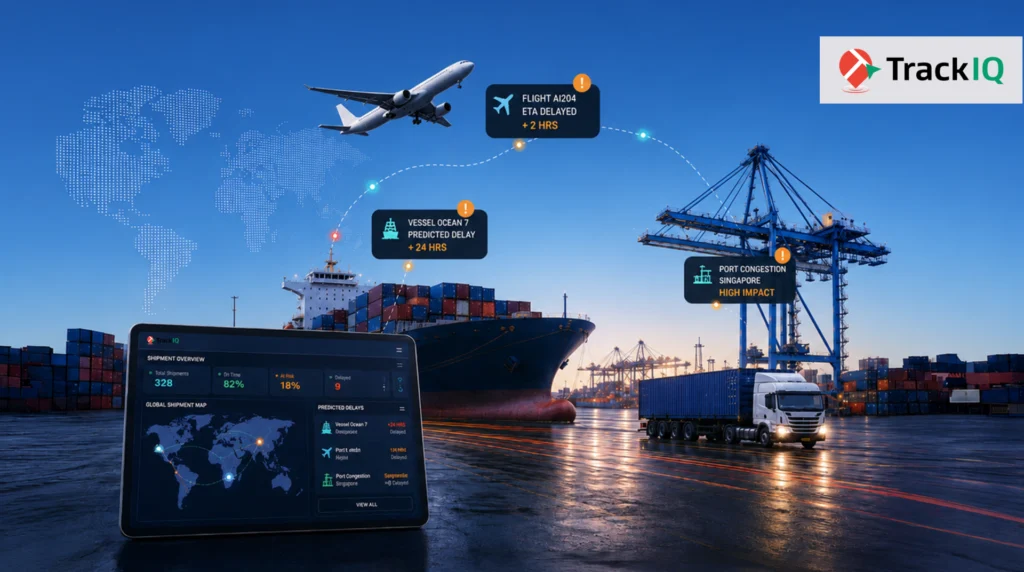
A forwarder managing 300+ ocean and air shipments across Asia and Africa uses predictive visibility to track performance lane by lane.
When the system flags that congestion in Singapore is likely to delay transshipments bound for Mombasa by 24 hours, the operations team acts instantly, rerouting containers and updating delivery promises before customers even ask.
Instead of spending mornings checking carrier portals, planners spend them planning.
Visibility becomes a source of calm, not chaos.
That’s the true value of predictive visibility, it buys you time to stay ahead.
Track IQ: Turning Prediction Into Operational Advantage
At Track IQ, predictive visibility is not an add-on feature, it’s the foundation.
We built it for logistics professionals who understand that visibility isn’t about screens or dots on a map; it’s about control, confidence, and accountability.
Here’s how Track IQ delivers:
- End-to-End Tracking: Ocean and air freight data unified in one intelligent dashboard.
- Predictive ETA Engine: Real-time forecasting using vessel patterns, weather, and congestion analytics.
- Actionable Alerts: Intelligent notifications that focus on what truly impacts delivery.
- Integration-Ready: Seamless connection with your ERP, TMS, or customer systems.
Track IQ transforms visibility from a reporting tool into a decision-making partner, keeping teams informed, aligned, and in control.
Visibility That Thinks Ahead, The New Standard for Supply Chains
The logistics industry has always been about movement. But the leaders of the next decade will win not by moving faster, but by seeing sooner.
Predictive visibility is how modern supply chains think, plan, and adapt. It makes logistics resilient, customer-centric, and ready for what’s next.
Every delay tells a story.
With predictive visibility, that story no longer ends in disruption, it ends in preparation.